By: Rebecca Lancaster, Madilyn Robinson, and Savannah Ledo (Stonehill College, BIO323: Evolution, Spring 2025)
Overview
The Costus genus, commonly known as spiral gingers, is in the Costaceae family and is distinguished from other gingers by its unique spiraling leaves. Costus comprises over 80 species of perennial herbaceous plants native to Central and South America. Previous research demonstrates the Costus genus has independently evolved from the ancestral bee-pollination trait to hummingbird pollination multiple times. In The Convergent Evolution of Hummingbird Pollination Results in Repeated Floral Scent Loss Through Gene Downregulation, Dr. Kathy Darragh and her team examined over 30 Costus species’ floral scent compositions to understand how the species evolved from bee to hummingbird pollination. The study highlights the importance of selection, where certain traits are favored while others are lost to conserve energy costs. By comparing floral scent compounds, emission, and gene expression between bee-pollinated and hummingbird-pollinated Costus species, we gain a deeper understanding of the genetic factors driving floral scent evolution.
The Research
This study, published in 2025 in Molecular Biology and Evolution by Kathy Darragh, Kathleen M. Kay, and Santiago R. Ramirez, investigates the repeated loss of floral scent in hummingbird-pollinated flowers and its genetic basis. Floral scent plays a crucial role in attracting pollinators, but many flowers that transition from being pollinated by bees to hummingbirds lose their scent completely. The article focuses on species in the Costus genus, in which hummingbird pollination has evolved multiple times independently. Lead scientist Dr. Darragh explores how this shift affects floral scent production at the chemical and genetic levels.
The researchers collected and analyzed floral scent compounds and compared the chemical profiles of bee- and hummingbird-pollinated species. They also used RNA sequencing and whole genome analysis to determine the cause of scent loss. Additionally, they used phylogenetic analyses (i.e., made a family tree) to track when and how often scent loss has occurred in the Costus genus. The study reveals that hummingbird-pollinated flowers simply have turned down scent-producing genes rather than losing them through a process called gene downregulation. The study shows how strong environmental pressures, like change in pollinators, can quickly change plant traits by studying flower scents, gene activity, and plant evolution.
Results
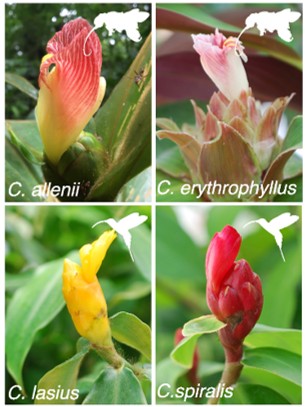
The results indicated that bee-pollinated Costus flowers produce a wider variety of stronger scents than hummingbird-pollinated ones. On average, bee-pollinated flowers release nine different scent compounds, while hummingbird-pollinated ones emit only two. For a specific comparative example, Costus allenii (bee-pollinated) gives off 24 scent compounds, whereas Costus lasius (hummingbird-pollinated) produces just three. The bee-pollinated flowers release more scent compounds, especially terpenes, which are known to attract bees. One of the main compounds detected was beta-ocimene, a common chemical that draws insects. In contrast, hummingbird-pollinated flowers, which rely more on color and shape to attract birds, produce little or no noticeable fragrance. The difference is not due to the loss of scent-related genes but to a drop in their activity. Both bee- and hummingbird-pollinated flowers have a similar number of scent-producing genes, but in hummingbird-pollinated flowers, these genes are barely active.
In C. allenii, scent-related genes make up 12% of the flower’s total gene activity, while in C. lasius, they account for only 0.00014%. This dramatic decrease in gene activity explains why hummingbird-pollinated flowers have weaker or no scent. Interestingly, this change in scent production occurred rapidly within a short evolutionary timeframe, suggesting that the reduction in floral scent is a relatively quick adaptation to hummingbird pollination. This finding suggests that as some Costus species adapted to attract hummingbirds, they gradually reduced their scent production by lowering the activity of these genes. This demonstrates how shifts in pollinators can quickly and repeatedly drive changes in flower scent through gene regulation rather than gene loss.
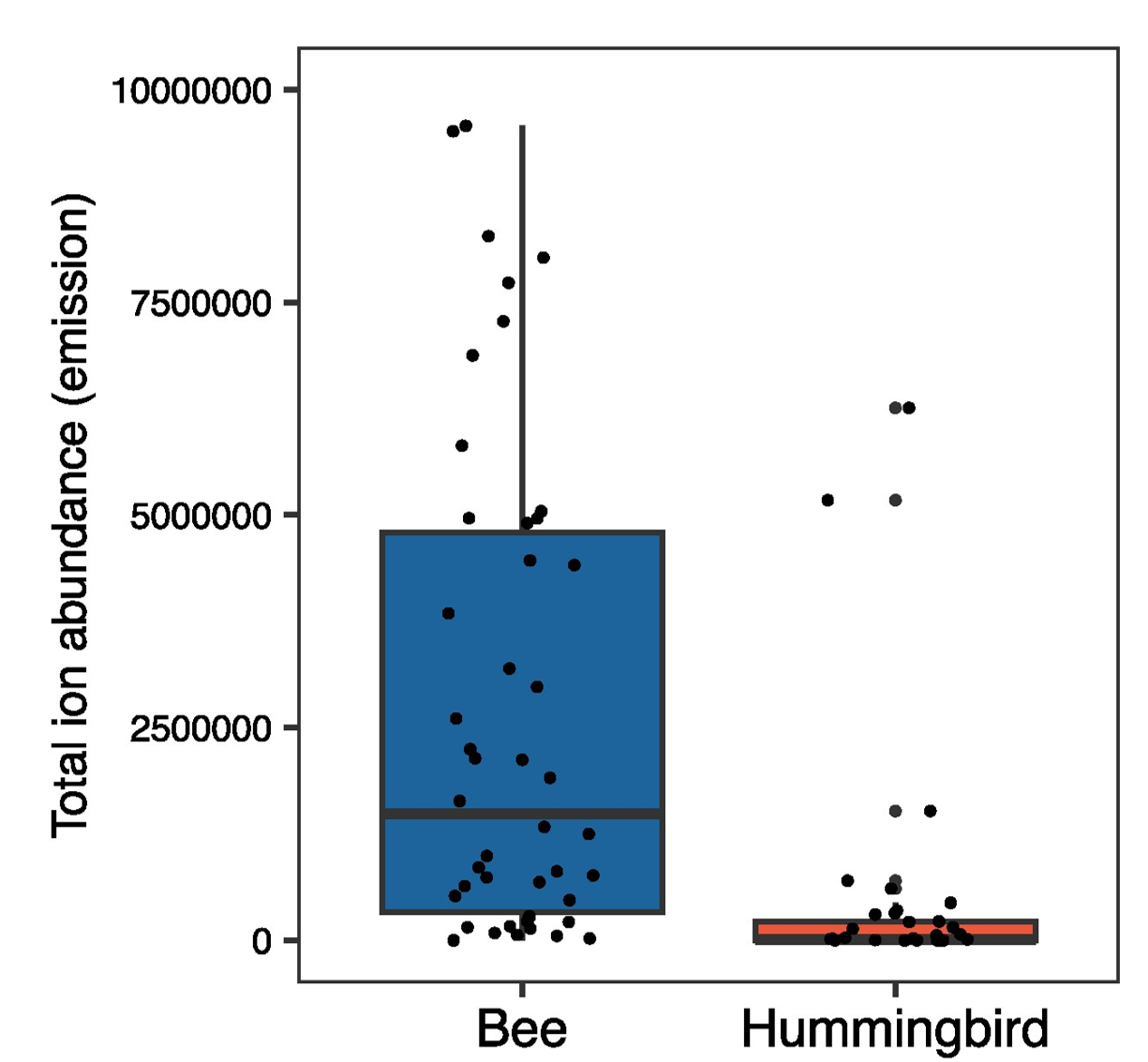
The phylogenetic analysis showed clear differences between the bee and hummingbird populations in the number and types of compounds they produced, especially beta-ocimene. It also revealed that scent loss occurred multiple times independently across the evolutionary tree, demonstrating convergent evolution as the same trait was lost in separate lineages.
Overall, the study on Costus flowers shows that those pollinated by bees produce much stronger and more complex scents than those pollinated by hummingbirds. However, as some Costus species evolved to rely on hummingbirds instead of bees for pollination, they gradually stopped producing strong floral scents.
Article: Darragh, K., K.M. Kay, & S.R. Ramírez. 2025. The convergent evolution of hummingbird pollination results in repeated floral scent loss through gene downregulation. Molecular Biology and Evolution 42: msaf027. https://doi.org/10.1093/molbev/msaf027
Find out more about the lead author here: https://kathydarragh.com.
Interesting article. Was not ware of this
Great job!!!
Very interesting. Nature is such a fascinating thing and we are never too old to learn.