By: Emily Desrosiers, Molly Nyhan, and Tyler Umbra (Stonehill College, BIO323: Evolution, Spring 2026)
In the forests of Europe and Asia, there is a group of small, greenish birds called leaf-warblers. These birds look physically identical to the average person as well as many experts. For years, they have been an evolutionary puzzle: how do species that look so similar end up living in such vastly different environments?
To answer questions like these, researchers make use of phylogenetic trees—diagrams that show how different groups of living things are related and from whom they evolved. If we can trace the ancestry of a bunch of these leaf-warblers, surely, we can get a picture of how and when they spread across vast distances, right? This is where the work of Gräf et al. (2025) comes in, with their recent article published in the journal Diversity, titled “Climate-Niche Evolution in Leaf-Warblers (Aves: Phylloscopidae): A Matter of Phylogeny”.
Phylogenetic trees are often considered incomplete or contradictory because different trees are built using different sets of DNA evidence. As such, these researchers wondered whether using two different versions of the leaf-warbler family tree would change the story of their evolution. They ran two trees (Fig. 1) through computer models to test the rate that distance grew between the climatic niches of different groups of leaf-warblers. A climatic niche is like a bird’s “comfort zone” with regard to weather conditions, such as temperature, precipitation, and humidity.
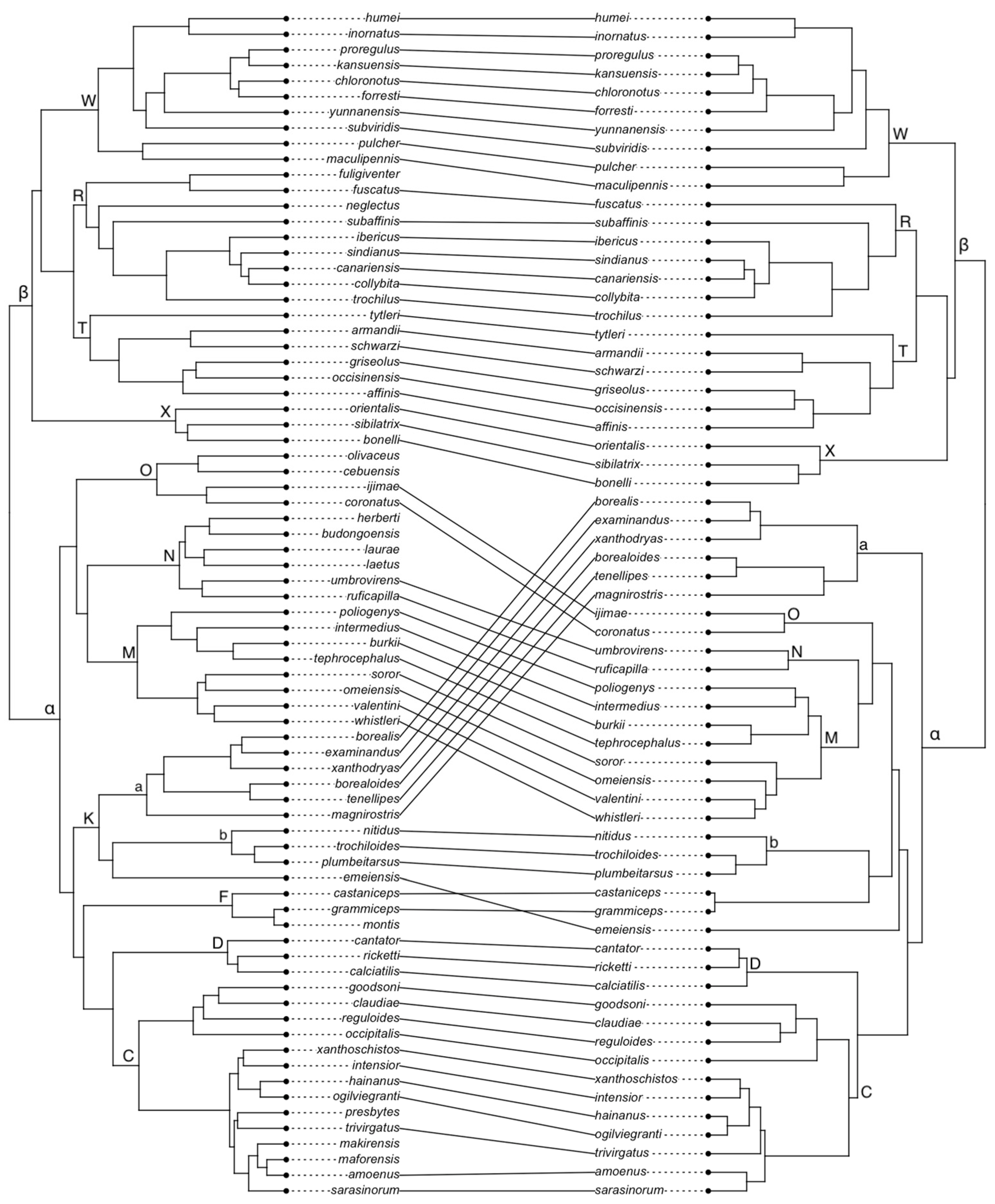
The results showed that the choice of family tree sometimes reversed the entire story to these birds’ evolution. TreeA suggested that the birds’ climate preferences changed slowly and steadily over millions of years; in contrast, TreeT showed stagnation for a long time followed by a sudden, rapid burst of evolution near the present day. This means that depending on which tree a scientist picks, they might conclude that these birds are more conservative, stubborn homebodies or highly flexible, enterprising pioneers.
Despite these differences, some patterns held true across both trees. For example, migratory birds tolerated much wider ranges of temperature than non-migratory birds. Their results also showed that birds from groups which have been around longer often ended up living in similar climates even if they weren’t closely related. This convergence effect, too, appeared when they used both trees.
This information is important because it can provide insight into how climate change is going to affect different species. Most of the time, we use these phylogenetic trees to predict which animals would be at the highest risk of extinction. If the tree suggests that the animal is flexible, we might assume that they can handle a warming planet. However, if these conclusions are based on an inaccurate family tree, our predictions could be wrong. This study acts as a warning sign to scientists. With a world that is constantly changing, it is important to conduct research and make conclusions taking into consideration the whole picture. Scientists shouldn’t just trust one tree of evolutionary history over the other, but they need to test their conclusions and theories against other maps of phylogeny to ensure that their findings are solid.
Article: Gräf, L., E.M. Griebeler, J. Oldeland, & D.T. Tietze. 2025. Climate-niche evolution in leaf-warblers (Aves: Phylloscopidae): A matter of phylogeny. Diversity 17: 844. https://doi.org/10.3390/d17120844
This is so cool! Love you, Molly
Good job Molly and team!
This is a really interesting topic! So glad you shared this Molly!